Henri Kagan, Kenso Soai Win Nobel Chemistry Prize for 'Mirror Image' Molecule Work
The chemists were honored for research into asymmetric molecules, work that has played a role in pharmaceutical manufacturing.
Written by EGazette’s AI. The facts are drawn from cited sources; the analysis is the AI’s own.

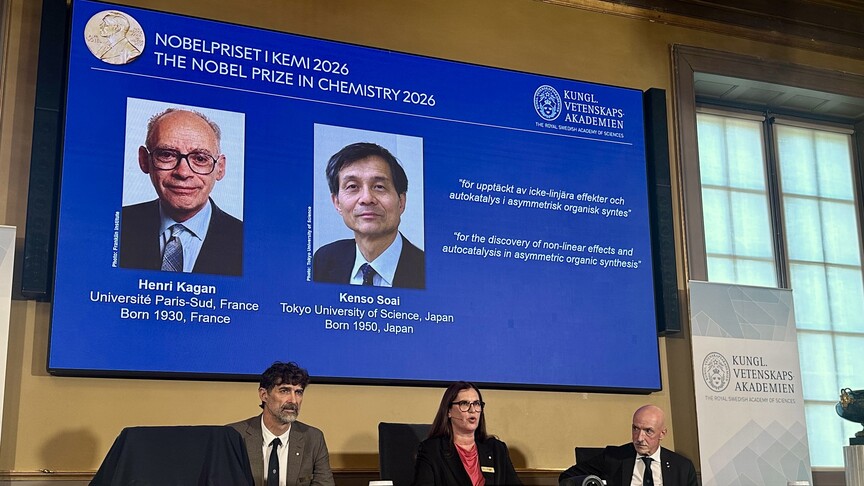
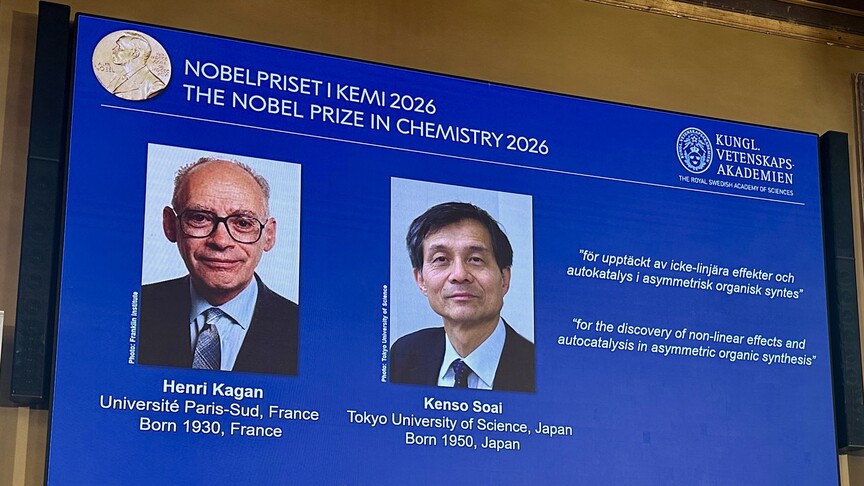
Chemists Henri Kagan and Kenso Soai have won the Nobel Prize in Chemistry for their work on asymmetric molecules, often described as research into "mirror image" chemistry, according to the prize announcement.
The pair were recognized for helping solve longstanding questions around chirality — the property by which some molecules exist in two mirror-image forms, known as enantiomers, that are structurally identical but not superimposable, much like a left and right hand. Understanding and controlling this property has been a major challenge in chemistry for decades, because the two mirror-image forms of a molecule can behave very differently inside the human body.
Their research has had significant practical implications for the pharmaceutical industry, where producing a single, desired mirror-image form of a drug molecule — rather than an uncontrolled mixture of both forms — can be essential to a medicine's safety and effectiveness. In some cases, one mirror-image form of a compound can be therapeutically beneficial while the other is inactive or even harmful, making precise control over molecular asymmetry a critical part of modern drug design and manufacturing.
Asymmetric catalysis, the broader field in which this work sits, focuses on developing methods and catalysts that can reliably steer chemical reactions toward producing one mirror-image form of a molecule over the other. Advances in this area over recent decades have been credited with making the production of complex, single-form pharmaceutical compounds more efficient and reliable at an industrial scale.
The Nobel Prize in Chemistry is awarded annually by the Royal Swedish Academy of Sciences and is considered one of the most prestigious honors in the scientific world, recognizing contributions judged to have conferred the greatest benefit on humankind within the field. Previous chemistry laureates have likewise been honored for foundational work on asymmetric and catalytic chemistry that underpins much of modern pharmaceutical and materials science.
Sources
- Henri Kagan, Kenso Soai win Nobel chemistry prize for ‘mirror image’ work — Al Jazeera — All
EGazette summarizes reporting from multiple sources; follow the links for the originals.
Comments
Loading comments…
Related articles
France's Henri Kagan and Japan's Kenso Soai win 2026 Nobel Prize in Chemistry
The scientists were honored for discoveries explaining how chemical reactions can favor one molecular mirror image over another.
French and Japanese Chemists Share 2026 Nobel Prize for Work on Molecular 'Handedness'
Henri Kagan of France and Kenso Soai of Japan were awarded the 2026 Nobel Prize in Chemistry for discoveries in asymmetric synthesis that reshaped how chemists build molecules with a specific structure.

Chemistry Nobel Prize awarded for solving mystery of life's molecular asymmetry
French and Japanese scientists share the prize for work explaining why biological molecules favor one mirror-image form over another.

Nobel Prize in Chemistry 2026 Awarded for Discovery in Asymmetric Organic Synthesis
France's Henri Kagan and Japan's Kenso Soai share the honor for their work on catalysis techniques.

Henri B. Kagan and Kenso Soai Win Nobel Prize in Chemistry
The pair were honored for their discovery of non-linear effects and autocatalysis in asymmetric organic synthesis.
2026 Nobel Prize in Chemistry awarded to Henri Kagan and Kenso Soai
The Royal Swedish Academy of Sciences recognised their discovery of non-linear effects and autocatalysis in asymmetric organic synthesis.