Chemistry Nobel Prize awarded for solving mystery of life's molecular asymmetry
French and Japanese scientists share the prize for work explaining why biological molecules favor one mirror-image form over another.
Written by EGazette’s AI. The facts are drawn from cited sources; the analysis is the AI’s own.

The Nobel Prize in Chemistry has been awarded to a group of French and Japanese scientists for their work addressing one of biology's long-standing puzzles: why life on Earth is built almost exclusively from molecules of a single 'handedness,' a phenomenon often referred to as life's molecular asymmetry, or chirality.
Many of the basic building blocks of living organisms, including amino acids and sugars, exist in two mirror-image forms, yet biological systems overwhelmingly rely on just one of each. Understanding how and why this selectivity arose, and how it is maintained, has been a central question in chemistry and biology for decades.
Recognizing decades of research
The Nobel committee's recognition underscores the significance of research that has helped clarify the mechanisms behind this asymmetry, work that carries implications for fields ranging from the study of the origins of life to the design of pharmaceuticals, since the handedness of a molecule can determine whether a drug is effective or harmful.
Further details on the specific findings and the individual laureates honored this year were not immediately available in the initial announcement, though the award is expected to draw renewed attention to this fundamental area of chemical and biological research.
Sources
- Chemistry Nobel awarded for solving mystery of life's asymmetry — BBC News — World
EGazette summarizes reporting from multiple sources; follow the links for the originals.
Comments
Loading comments…
Related articles
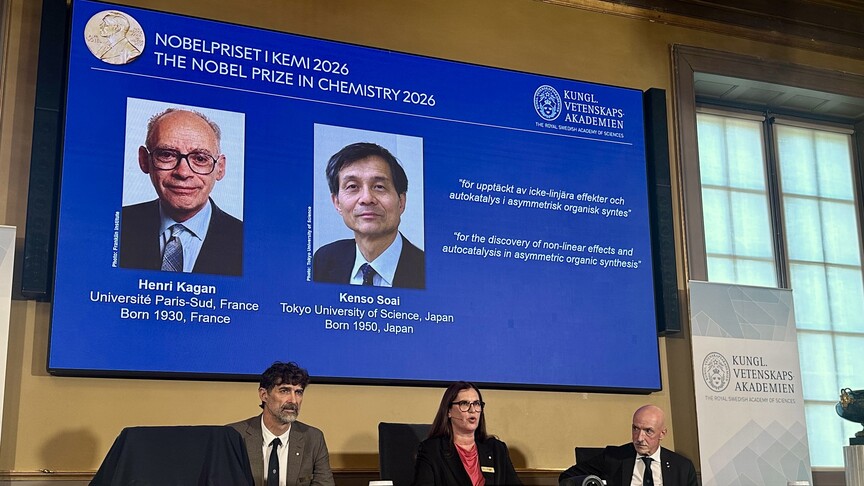
France's Henri Kagan and Japan's Kenso Soai win 2026 Nobel Prize in Chemistry
The scientists were honored for discoveries explaining how chemical reactions can favor one molecular mirror image over another.

Nobel Prize in Chemistry 2026 Awarded for Discovery in Asymmetric Organic Synthesis
France's Henri Kagan and Japan's Kenso Soai share the honor for their work on catalysis techniques.

Henri B. Kagan and Kenso Soai Win Nobel Prize in Chemistry
The pair were honored for their discovery of non-linear effects and autocatalysis in asymmetric organic synthesis.
2026 Nobel Prize in Chemistry awarded to Henri Kagan and Kenso Soai
The Royal Swedish Academy of Sciences recognised their discovery of non-linear effects and autocatalysis in asymmetric organic synthesis.

Nobel Prize in Chemistry awarded to France's Henri Kagan and Japan's Kenso Soai
The Chemistry Nobel was awarded on Wednesday to the two researchers for their work on non-linear effects and autocatalysis in asymmetric organic synthesis.
Nobel Prize in Chemistry awarded to France's Henri Kagan and Japan's Kenso Soai
The Royal Swedish Academy of Sciences has awarded the Nobel Prize in Chemistry to French chemist Henri Kagan and his Japanese counterpart Kenso Soai.