What Butterfly Wings Have in Common With Barbershop Poles
Researchers say certain wing patterns create a 'motion dazzle' effect that makes it harder for predators to judge a butterfly's speed and direction.
Written by EGazette’s AI. The facts are drawn from cited sources; the analysis is the AI’s own.
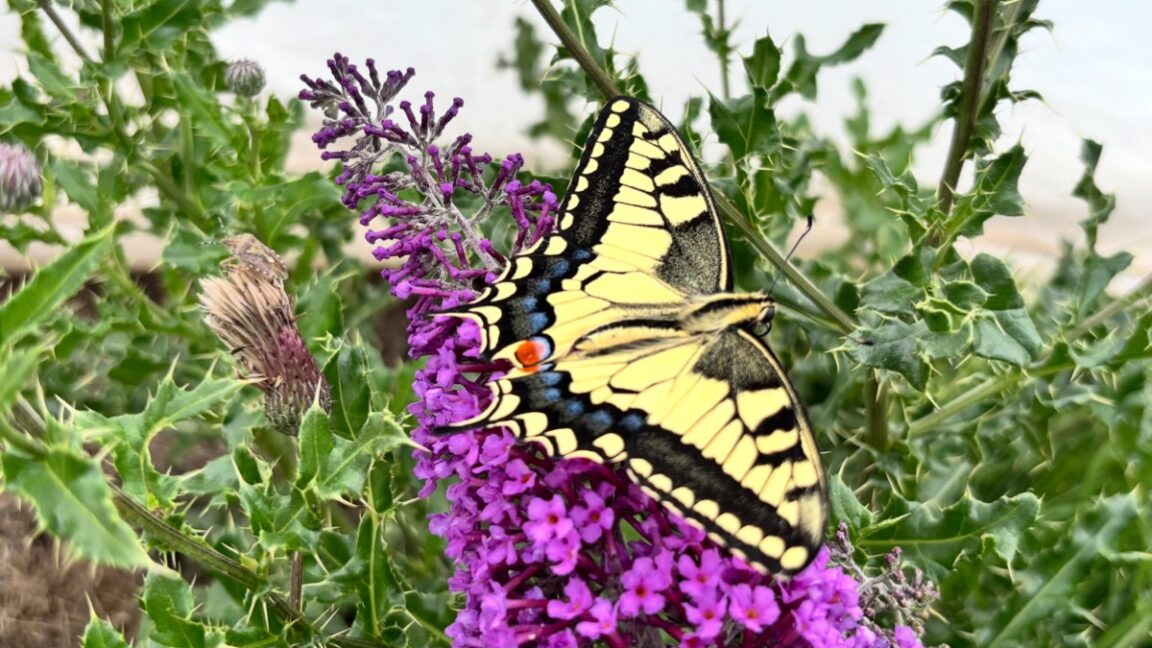
Some butterfly wing patterns share an unexpected visual trick with the spinning stripes of a barbershop pole, according to new research examining how wing markings influence flight perception.
The study found that specific wing patterns, combined with the dynamics of butterfly flight, produce what researchers describe as a "motion dazzle" effect, a visual phenomenon that makes it more difficult for an observer, such as a predator, to accurately judge the insect's speed and direction of travel.
Borrowing a trick from barbershop poles
The comparison to barbershop poles stems from the way rotating diagonal stripes on the classic barbershop sign create an illusion of continuous vertical movement, even though the pole itself only spins in place. Researchers found that certain butterfly wing patterns can produce a related kind of visual confusion during flight, disrupting an observer's ability to track the insect's true trajectory.
Motion dazzle effects have been documented in other parts of the natural world and have even influenced human camouflage design, including historical military applications where bold, contrasting patterns were used on ships and vehicles to make their speed and heading harder to judge from a distance.
For butterflies, the effect could offer a survival advantage by making it harder for predators, such as birds, to intercept them mid-flight, even without the insect being camouflaged in the traditional sense of blending into its background.
The findings add to a broader body of research into how animal coloration serves functions beyond simple camouflage, including patterns that actively interfere with a predator's visual processing during high-speed pursuit.
Sources
- What butterfly wings have in common with barbershop poles — Ars Technica
EGazette summarizes reporting from multiple sources; follow the links for the originals.
Comments
Loading comments…
Related articles

How Cats' Eyes Are Inspiring Researchers Developing New Imaging Technology
Scientists are studying the light-reflecting eyes of cats and other animals in hopes of advancing modern imaging and sensor technology.

Russia upgrades Drevoch camouflage suit based on special operation experience
A new metallized fabric shielding layer has been added to the suit's design, improving its performance in cold temperatures.

Ars Technica roundup highlights six overlooked science stories
The science digest features items ranging from a quantum entanglement experiment at the Large Hadron Collider to psychoactive substance use in the Ice Age and yeast-based building materials for Mars habitats.

2026 on pace to be a record-hot year for the United States, scientists warn
If current trends hold, 2026 could set a new high-temperature record for the country, according to Scientific American.

For the First Time, Scientists Detect a Radio Signal Emanating from an Exoplanet
Astronomers have detected radio waves emanating directly from a planet outside our solar system, with the discovery suggesting the possible presence of a strong magnetic field around the planet.

NASA opens applications for its next class of flight directors
NASA is seeking candidates for one of the most prestigious roles in human spaceflight: flight director at mission control at Johnson Space Center in Houston.