Mysterious high-energy neutrino may be linked to an exploding primordial black hole
An unexplained particle detected three years ago could point to a primordial black hole more unusual than previously thought, researchers say.
Written by EGazette’s AI. The facts are drawn from cited sources; the analysis is the AI’s own.

An unexplained high-energy neutrino detected three years ago may be linked to a primordial black hole, according to Scientific American.
Researchers have suggested that the particle's origin could involve a black hole even more unusual than those previously theorised, potentially resulting from a black hole effectively "exploding" under extreme physical conditions.
Neutrinos are notoriously difficult to detect and trace to their source because they interact only weakly with matter, making events like this one a focus of ongoing scientific investigation.
The hypothesis linking the neutrino to a primordial black hole remains a subject of scientific inquiry, and further observations would be needed to confirm or rule out the connection.
If confirmed, the finding could offer new insight into the nature and behaviour of primordial black holes, a class of objects that remains largely theoretical.
Sources
- This weird particle may have come from a black hole exploding in another dimension — Scientific American
EGazette summarizes reporting from multiple sources; follow the links for the originals.
Comments
Loading comments…
Related articles
Ars Technica roundup highlights six overlooked science stories
The science digest features items ranging from a quantum entanglement experiment at the Large Hadron Collider to psychoactive substance use in the Ice Age and yeast-based building materials for Mars habitats.

2026 on pace to be a record-hot year for the United States, scientists warn
If current trends hold, 2026 could set a new high-temperature record for the country, according to Scientific American.

For the First Time, Scientists Detect a Radio Signal Emanating from an Exoplanet
Astronomers have detected radio waves emanating directly from a planet outside our solar system, with the discovery suggesting the possible presence of a strong magnetic field around the planet.

NASA opens applications for its next class of flight directors
NASA is seeking candidates for one of the most prestigious roles in human spaceflight: flight director at mission control at Johnson Space Center in Houston.
NASA Campaign Explores Clouds Spawned by Wildfires
Scientists on the INSPYRE mission spent weeks chasing an elusive pyrocumulonimbus cloud triggered by Idaho's Wildhorse fire.
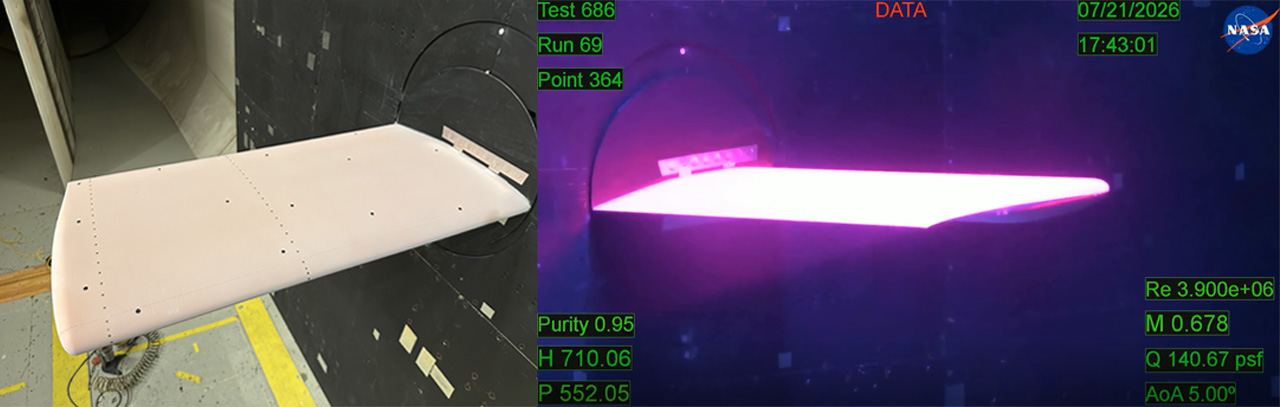
NASA Tests New Pressure Sensitive Paint Technique on Wind Tunnel Model Wing
Researchers at NASA's Langley Research Center used unsteady pressure sensitive paint for the first time to study airflow around a wind tunnel model, a step toward new aircraft design capabilities.