Guardian Editorial Questions Bank of England's £120bn Quantitative Tightening Bill
An opinion piece in The Guardian argues that the Bank of England's bond-selling programme has blurred the boundary between monetary and fiscal policy, leaving ministers liable for costs they cannot control.
The Guardian's Business section published an editorial on 15 September 2026 examining the financial implications of the Bank of England's quantitative tightening (QT) programme, which the piece says could cost the UK Treasury as much as £120bn.
According to the editorial, the Bank of England disclosed in August that its policy of selling government bonds accumulated during quantitative easing (QE) could result in this substantial cost to public finances. The piece states that last year ministers paid the Bank £17bn to cover what the editorial describes as "arguably notional losses," an amount it says was larger than the budget of the Ministry of Justice.
The Guardian recalls that when Labour granted the Bank of England independence in 1997, the intended division of responsibility was that the Bank would set interest rates while the Treasury would handle taxation and spending — monetary policy separate from fiscal policy. The editorial argues that this arrangement was designed for a period when monetary policy decisions had only indirect fiscal consequences.
The piece contends that a series of crises — the 2008 financial crisis, the Covid-19 pandemic, war, and trade disputes — have altered this landscape. During these events, the Bank purchased large quantities of government bonds through its QE programme to support the economy. The editorial argues that the institutional framework, which leaves an independent central bank to determine what to do with these bond holdings, has not kept pace with these changes.
The editorial cites Charlie Bean, a former deputy governor of the Bank of England, who it says has acknowledged that central bank independence cannot justify granting the unelected Monetary Policy Committee (MPC) effective control over decisions with major consequences for public spending.
The Guardian's editorial calls for the current arrangement — under which the Treasury indemnifies the Bank of England for losses arising from its bond sales — to be reconsidered, arguing the policy "clearly ought to be rethought" and that the indemnification arrangement should end.
The Bank of England has not issued a public response addressed in this editorial, and the piece does not cite direct comment from Treasury officials.
Sources
- The Guardian view on the Bank of England’s £120bn bill: power without accountability | Editorial — The Guardian — Business
EGazette résume des articles de plusieurs sources ; suivez les liens pour les originaux.
Articles liés

L'inflation britannique remonte à 3,1 % en août face aux prix énergétiques plus élevés
Cette hausse, rapportée par CNBC, intervient quelques heures à peine avant l'annonce de sa dernière décision de politique monétaire par la Banque d'Angleterre.

La Réserve fédérale relève ses taux d'intérêt, suscitant de vives critiques de Trump
La première hausse de taux de la Réserve fédérale depuis 2023 a provoqué une réprimande immédiate du président Trump, tandis que le président de la Fed, Kevin Warsh, défend l'indépendance de la banque centrale.

La Banque nationale d'Ukraine relève son taux directeur à 16 %
La Banque nationale d'Ukraine a annoncé une décision d'augmentation de son taux directeur, selon Ukrinform.
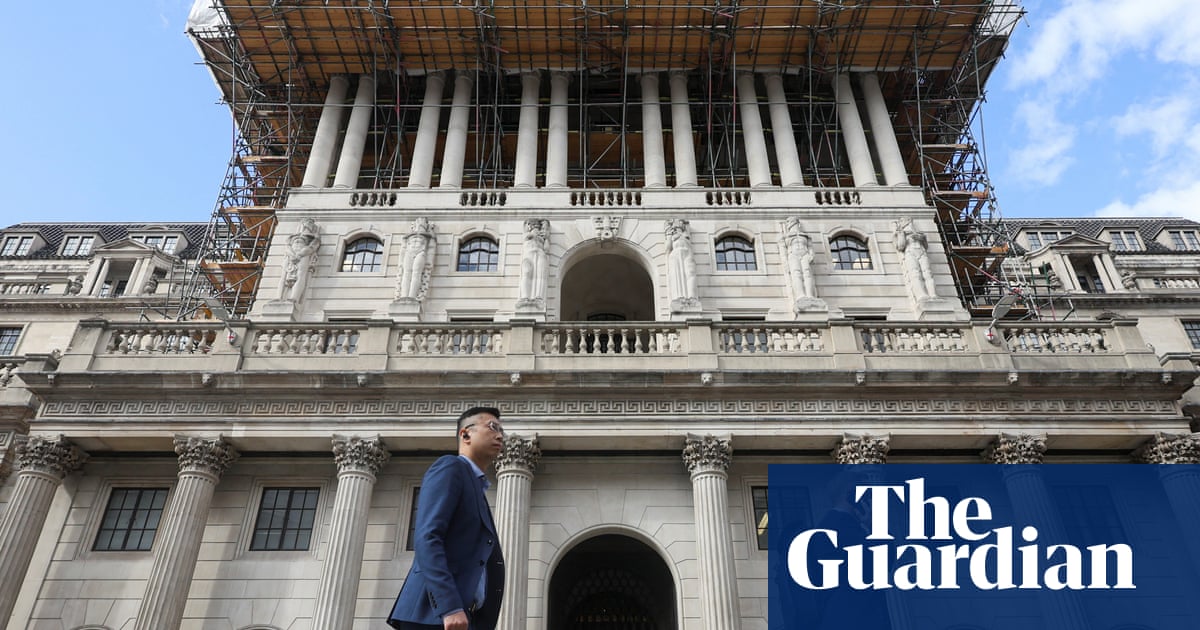
La Banque d'Angleterre maintient les taux à 3,75 % et avertit que le conflit au Moyen-Orient pourrait forcer des hausses futures
La banque centrale annonce aussi un plan surprise de vente d'obligations d'État au Trésor, une mesure qui pourrait affecter les finances publiques avant le budget du mois prochain.
Le ministre des Finances de l'opposition signale son intention de mettre fin à la présence des syndicats au conseil de la Banque d'Angleterre
Andrew Griffith déclare que la représentation syndicale au sein de l'organe de surveillance de la Banque pourrait nuire à sa réputation de discipline financière, tout en reconnaissant aussi les lacunes du programme Déclaration fiscale numérique.

La Réserve fédérale relève ses perspectives d'inflation et abaisse ses prévisions de chômage
La Réserve fédérale a révisé ses projections économiques, relevant sa perspective d'inflation pour 2026 tout en abaissant ses prévisions de chômage, selon l'Agence Anadolu.
Comments
Loading comments…