Europe's BepiColombo Spacecraft Nears Mercury After Eight-Year Journey
The joint European-Japanese mission is on its final approach to the solar system's innermost planet, with scientists hoping to uncover clues about Mercury's origins.
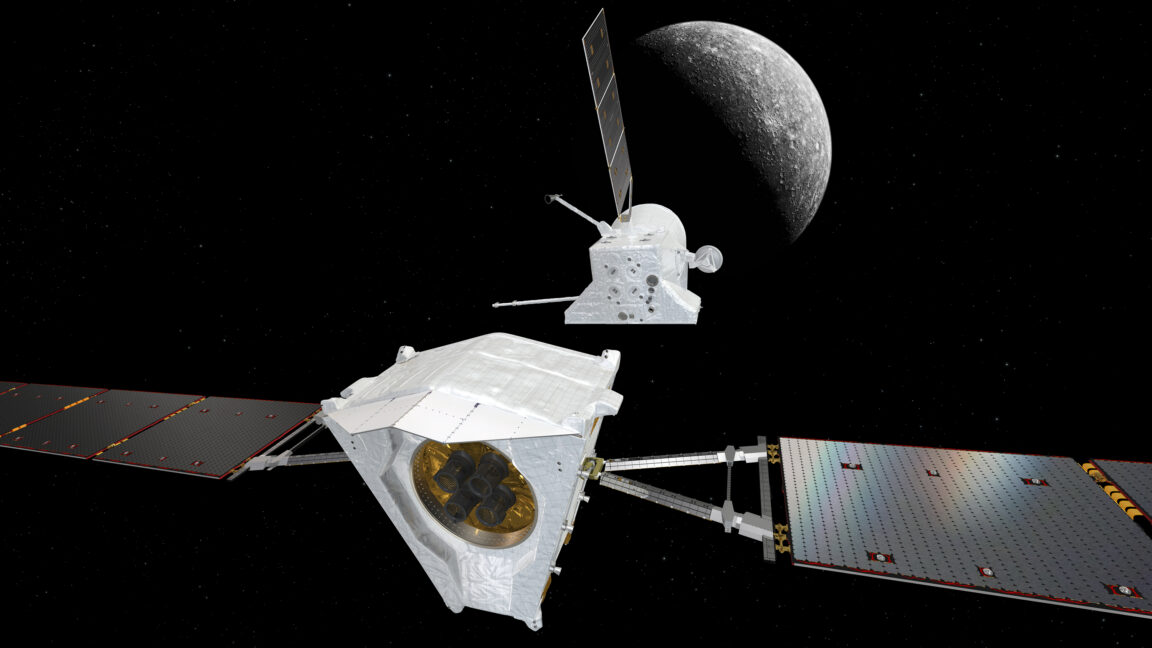
The BepiColombo spacecraft, a joint mission of the European Space Agency (ESA) and the Japan Aerospace Exploration Agency (JAXA), is on its final approach to Mercury after an eight-year journey through the solar system, according to a report by Ars Technica.
The mission, which launched in October 2018, has taken a long and complex route to reach Mercury, using a series of gravity-assist flybys of Earth, Venus, and Mercury itself to shed enough speed to be captured by the planet's gravity.
According to the report, scientists involved in the mission are focused on understanding how Mercury formed and evolved into its current state. "Fundamentally, we want to learn about the origins of this planet and how it came to be like it is," one mission scientist told Ars Technica.
BepiColombo consists of two separate orbiters that will eventually separate and study Mercury from different vantage points: ESA's Mercury Planetary Orbiter, which will examine the planet's surface and composition, and JAXA's Mercury Magnetospheric Orbiter, known as Mio, which will study Mercury's magnetic field and its interaction with the solar wind.
Mercury remains one of the least explored planets in the solar system, with only two previous missions—NASA's Mariner 10 in the 1970s and MESSENGER, which orbited the planet from 2011 to 2015—having visited it directly. Scientists have said Mercury's extreme proximity to the sun, its unusually dense composition, and its cratered, heavily processed surface make it a valuable subject for understanding the early formation of rocky planets.
Ars Technica reported that the spacecraft's arrival marks a significant milestone for the mission, which has spent years navigating the technical challenges posed by the sun's intense gravity and heat near Mercury's orbit.
Sources
EGazette summarizes reporting from multiple sources; follow the links for the originals.
Related articles
European Space Agency Launches Two Satellites to Monitor Climate Change
The new satellites will help scientists study the effects of climate change, with one instrument dedicated to observing plant life

Poison suspected in deaths of ten lions at Tanzania game reserve
The lions were discovered dead in the Ngorongoro Conservation Area, prompting wildlife officials to investigate.

Exceptional Discovery of Denisovan Fossils in a Southwestern Chinese Cave
Extremely rare remains of these Asian "cousins" of Neanderthals have been unearthed alongside stone tools, shedding new light on their way of life.

Scientific American's October Retrospective Looks Back at Smallpox, Skyscrapers and Racetrack Research
A historical column published by Scientific American revisits science and technology milestones from 50, 100 and 150 years ago, touching on smallpox eradication efforts, skyscraper excavation work and research conducted at racetracks.

NASA's Astronomy Picture of the Day Features Analemma Over Scotland's Callanish Stones
The September 20, 2026 edition of NASA's long-running APOD series highlights a composite image showing the sun's yearly path above the ancient Callanish Stones.

New Archaeological Evidence Points to Hidden Passages Behind Tutankhamun's Tomb
Archaeological study reopens the file on the lost tomb of Queen Nefertiti after detecting indicators of undiscovered chambers and passages behind the walls of the young pharaoh's tomb in the Valley of the Kings
Comments
Loading comments…