Benchmarking Large Language Models: A Real-World Test in High-Throughput Media Processing
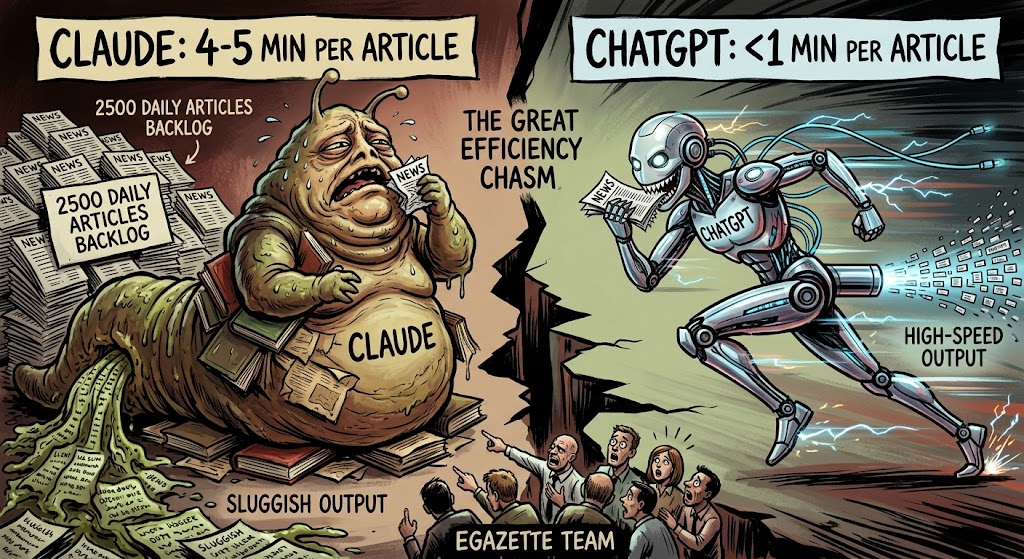
In a head-to-head comparison between Anthropic's Claude and OpenAI's ChatGPT/GPT-4 models, a substantial disparity in processing speed was revealed.
To optimize pipeline execution, tasks are divided into online agents (handling real-time ingestion) and offline scheduled agents (batch-processing hourly batches).

Analyzing the Bottlenecks: Why the Speed Difference?
As an impartial judge analyzing this performance benchmark, several architectural factors explain the ~5x speed variance between the two ecosystems:
1. Token Generation Speed & Output Overhead
Claude (Anthropic): Claude models (such as Claude 3.5 Sonnet or Opus) are renowned for detailed reasoning, nuanced writing, and adherence to complex system prompts. However, their raw generation speed (tokens per second) can be slower, particularly on batch or scheduled API workloads.
ChatGPT/GPT-4o (OpenAI): OpenAI's latest flagship models (like GPT-4o or GPT-4o-mini) are heavily optimized for low latency and high token-per-second output.
2. Multi-Agent Overhead Amplification
Because the workflow routes every single article through 12 sequential/parallel agent prompts, any slight latency per agent gets multiplied 12 times:

A 20-second latency per agent in Claude totals 240 seconds (4 minutes).
A 4-second latency per agent in OpenAI totals 48 seconds (< 1 minute).
3. Rate Limits & Scheduling Queues
Scheduled, offline API requests on Anthropic can experience queueing delays depending on Tier rate limits (TPM/RPM), whereas OpenAI's infrastructure often handles bursty batch loads with lower queue latency.
Key Takeaways for Developers
Hybrid Architecture Might Be Optimal: Use faster models (e.g., GPT-4o-mini / GPT-4o) for high-volume, structural steps (classification, harvesting formatting, scoring) and reserve high-reasoning models (Claude 3.5 Sonnet) for qualitative tasks like translation nuance or deep editorial synthesis.
Parallel Agent Execution: Look for multi-agent stages that can execute concurrently rather than sequentially (e.g., scoring and translating at the same time).
Structured Outputs: Enforcing JSON Mode / Structured Outputs across agents significantly speeds up generation times by cutting out conversational filler.
Related articles

Update: LinkedIn beats "BrowserGate" lawsuits over scanning users' Chrome extensions
A report from Ars Technica sets out the main available details, with claims kept attributed to their sources.
Update: AI has finally come for math—mathematicians might never recover
A report from Scientific American sets out the main available details, with claims kept attributed to their sources.
The iPhone Duo was the unequivocal star of Apple's "Surprise and shine" event, but not for people who were mostly paying attention for news on wearables
A report from The Verge sets out the main available details, with claims kept attributed to their sources.

Update: We unfolded the iPhone Duo
A report from The Verge sets out the main available details, with claims kept attributed to their sources.
Update: Mathematicians confront the AI apocalypse
A report from Scientific American sets out the main available details, with claims kept attributed to their sources.

Update: Claude users found ways around safeguards for bioweapons research
A report from Ars Technica sets out the main available details, with claims kept attributed to their sources.
Comments
Loading comments…